


May 3, 2000 [Volume 1, Issue 12]
"To Your Health" is brought to you by:

This issue features a number of articles you will want to share with your
family, friends and co-workers. Please feel free to forward this newsletter
to them via e-mail. If you have received this e-mail newsletter from someone
else, you may subscribe free of charge and begin receiving your own copy
by going to:
https://www.chiroweb.com/find/tyh.html
In this issue of To Your Health:
- Missing Work Because of Back Pain
- Lots of Antibiotics, Little Success
- An Egg a Day Is Okay?
Missing Work Because of Back Pain
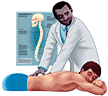 An
estimated 150 million workdays are lost each year because of back pain,
accounting for billions of dollars each year in lost wages and workers'
compensation claims. Of course, the issue of back pain goes far beyond
dollars and cents — it's about the frustration, discomfort and disability
millions of endure for months and sometimes years.
An
estimated 150 million workdays are lost each year because of back pain,
accounting for billions of dollars each year in lost wages and workers'
compensation claims. Of course, the issue of back pain goes far beyond
dollars and cents — it's about the frustration, discomfort and disability
millions of endure for months and sometimes years.
What specifically determines time loss from work following a back injury? To answer that question, the authors of a study in Spine evaluated the incidence of back injury and resultant work loss in a group of nurses employed at a large teaching hospital in Canada. Over a two-year period, 320 nurses suffered 416 documented back injuries, with the results of 218 interviews presented as follows:
- Perceived disability (i.e., thinking you were injured) contributed
to time loss following the injury;
- Self-reported pain was strongly related to the length of time lost;
and
- Type of injury, specifically back injury caused by lifting patients, resulted in greater time loss.
This study serves as yet another example of the magnitude of the back pain problem and the effects it can have on our physical, psychological and economic well-being. It's a reminder that prevention is the best way to avoid a back injury, and that a proven, successful way to prevent back pain (or relieve back pain after injury) is with regular adjustments from a doctor of chiropractic.
For more information on back pain, go to https://www.chiroweb.com/tyh/backpain.html
Reference: Tate RB, Yassi A, Cooper J. Predictors of time loss after back injury in nurses. Spine, Sept. 15, 1999: Vol. 24, No. 18, pp1930-36.
Lots of Antibiotics, Little Success
Otitis media refers to inflammation of the middle ear area just behind the eardrum. Two out of three children under the age of three suffer at least one episode of otitis media, and up to one third experience six or more episodes by the time they start school. Common symptoms include irritability, difficulty sleeping, fussiness (in younger children), and ear pain and hearing loss (in older children).
Antibiotics are standard treatment for this condition, even though little scientific evidence supports their use. A case in point comes from the British Medical Journal, which published a study comparing antibiotic treatment vs. placebo (no treatment) for acute otitis media. Among 53 general practices in the Netherlands, 240 children between six months and two years of age were randomly selected to receive amoxicillin or placebo. Results showed only slight differences between the two groups with regard to symptom resolution (more common in the antibiotic group at day four, but similar by day 11); duration of fever (shortened by one additional day in the antibiotic group); and crying and/or pain (no differences between the two groups).
The authors conclude that if seven to eight children with acute otitis media are given amoxicillin treatment, only one child will experience symptom improvement by day four. They suggest that the effectiveness of antibiotics for this condition is limited, especially in children under two years of age.
Contact your chiropractor for information on nonmedical approaches to resolving otitis media. To learn more about chiropractic management of other childhood conditions, visit https://www.chiroweb.com/tyh/childhood.html
Reference: Damoiseaux RAMJ, van Balen FAM, Hoes AW, et al. Primary-care-based randomized, double-blind trial of amoxicillin versus placebo for acute otitis media in children aged under 2 years. British Medical Journal, Feb. 5, 2000: Vol. 320, pp350-54.
An Egg a Day Is Okay?
The public and health care professions have been frustrated by the mixed messages about eggs: positive reports on the nutritional value of egg consumption, alternating with warnings that eating eggs can be unhealthy. The controversy may be ending, at least if you accept the position taken in this research paper, published in the prestigious Journal of the American Medical Association.
The study subjects (37,851 men, age 40-75, and 80,082 women, age 34-59), who were free of cardiovascular disease, diabetes, high cholesterol or cancer at the outset, returned diet questionnaires that included information on egg consumption. The men were followed-up over eight years and the women over 14 years, with no evidence shown of any significant association between egg consumption and coronary heart disease or stroke in men or women.
The dozen researchers involved in this study concluded that healthy men and women could safely consume up to one egg per day without substantially increasing their overall risk. Ask your chiropractor to outline a nutritional program appropriate to your health needs. For more information on nutrition, visit https://www.chiroweb.com/tyh/nutrients.html
Reference: Hu FB, Stampfer MJ, Rimm EB, et al. A prospective study of egg consumption and risk of cardiovascular disease in men and women. Journal of the American Medical Association, Apr. 21, 1999; vol. 281, no. 15, pp1387-94.
Unsubscribe Instructions:
Click this link
and enter your e-mail address to unsubscribe from this newsletter.
